Our Products > For water > BIOPAQ® IC anaerobic treatment
For water
BIOPAQ® IC
BIOPAQ® UASB
BIOPAQ® UASB+
BIOPAQ® AFR
BIOPAQ® UBOX
ASTRASAND®
ASTRASEPARATOR®
ANAMMOX®
CIRCOX®
THIOTEQ™
SULFATEQ™
BIOMETEQ™
DAF
PHOSPAQ™
For gas
For your sector
Contact
Brochure
BIOPAQ® IC

With the development of high rate Internal Circulation (IC) reactors, Paques has created the opportunity for industries with limited available space to treat their effluent, and in addition, both noise and odour issues have been addressed. Anaerobic effluent treatment with efficiently designed BIOPAQ® IC-reactors has become a proven technology, with hundreds of examples worldwide in various industrial sectors.


Advantages of the BIOPAQ® IC
•    production of consistent effluent qualities
•    compact, small, self regulating and highly efficient
•    production of ‘green’ energy-rich biogas
•    little biomass volume
•    a short hydraulic retention time
•    capable of dealing with high loading rates
•    use of biological alkalinity decreases customary neutralization costs
•    meets stringent requirements for odour emission, sludge production and purification grades
•    a complete range of models from standardized concepts
•    tailor made options for indoor as well as outdoor applications
•    wide-ranging application
•    short system start-up time
•    worldwide availability through network of licensees

Working principle
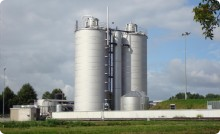
The BIOPAQ® IC reactor is a vertical tank (see picture), varying in height between 16 and 28 meters and in width between 1.5 and 15 meters. The influent is pumped into the bottom of the reactor using an efficient distribution system, and is mixed with the granular anaerobic biomass (1).

In the lower reactor compartment (2) most of the organic components are converted into methane and carbon dioxide. This gas mixture, or "biogas", is collected in the lower level phase separator (3). This generates a "gas lift", which forces the water upwards through the riser (4) into the liquid/gas separator on the top of the reactor (5). The biogas leaves the reactor through this separator, and the water returns through the downer (6) back to the bottom of the system: hence the name, Internal Circulation.

In the second, upper compartment the effluent is polished (7). The biogas formed here emerges from the polishing step and from the liquid phase. It is collected in the upper phase separator (8) while the effluent leaves the reactor from the top.

The self-regulating internal circulation offers considerable advantages in the operation of the system, leading towards reduced operational costs, increased productivity and reliability.